What an exciting night for the MAM to show Andy Warhol, an icon of Pop Art. Half expecting to see soup cans and Marilyn Monroe I was given the opportunity to see the last decade of his work. During this time he was his most prolific, producing more art than in his forty year career.
Although not given the critical acclaim that made him famous, this art was more exploratory and introspective. This decade he returns to painting, experimenting with his own ideas of morality and what his legacy should be.
One of the first projects to draw Warhol away from the precipice of the has-beens was his Shadows series of 1978-1979, big, looming chasms inky strangeness shot through with candy colors. There’s little to overtly suggest space or depth, but we get sensations — a passage, a room, a figure, perhaps? They’re unknowable and esoteric and connect with the Warholian contradiction of picturing nothingness, yet imbuing it with substance. As Keith Hartley suggests in his catalog essay, though Warhol deemed these works “disco decor,” their murky and mysterious nature, particularly when installed as a long, continuous frieze, becomes fraught with possibility and uncertainty.
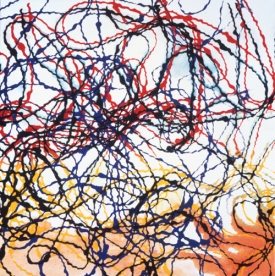
Andy Warhol, Yarn, 1983. Acrylic and silkscreen ink on linen, 40 x 40 in. (101.6 x 101.6 cm). The Andy Warhol Museum, Pittsburgh; Founding Collection, Contribution The Andy Warhol Foundation for the Visual Arts, Inc.
Warhol’s interest in abstraction is documented in a number of series. The Rorschach paintings are like psychology tests writ large – as much as 13-feet-tall large. The Oxidation Paintings and Yarn canvases also shun ordinary, painterly approaches; the former reveals the chemical reactions between urine and metallic pigments, and the latter grew from a commissioned project into giant canvases of squiggling, entwined, twisty lines. The quotations are unmistakable — the impulses of performance art and
Dada on one hand, and Abstract Expressionism Warhol-style on the other.
The most poignant images throughout Andy Warhol: The Last Decade are the self-portraits, and it’s almost impossible to look at this exhibition and these pictures without a poignant sense of death over your shoulder. Warhol explored self-portraiture in his youthful glory days of the ’60s, again in the late ‘70s into the dawn of the ‘80s, and lastly in 1986. These images have an unsettling power that transcends the context of their time. His face is often blurred and repeated. Skulls hover as reminders of our terminal mortality. In the last portraits, his iconic shock of silver hair appears electrified, and he is simultaneously hidden and revealed within a wash of camouflage. These are modern parallels to the arc of self-portraiture by predecessors, such as
Rembrandt van Rijn, wherein the youthful, self-assured and somewhat cocky painter is transformed through the unabashed frankness and exposed spirit in an older self.
It’s as though Warhol, a master of understated drama, fortuitously embarked on these themes just in time, as though feeling the sands of time were slipping. He was also re-energized through his work in the early 1980s with younger artists, such as Jean-Michel Basquiat and Francesco Clemente. These collaborations served as catalysts for Warhol to pick up actual paintbrushes once more.
Andy Warhol, The Last Supper, 1986. Acrylic and silkscreen on canvas, 78 x 306 in. The Baltimore Museum of Art, Purchase with exchange funds from the Harry A. Bernstein Memorial Collection. Photo: Mitro Hood.
The exhibition reaches a final crescendo with The Last Supper works, which originated in a project for a gallery in Milan, housed across from Santa Maria delle Grazie where Leonardo da Vinci painted his famed fresco between 1495 and 1498. These last images, as well as Warhol’s provocative Black and White Ads, give glimpses into the hidden Andy Warhol, suggesting his Catholic devotion and personal commentaries.
This exhibition, developed by former Milwaukee Art Museum chief curator Joseph D. Ketner II, who now holds a named chair at Emerson College in Boston, summarizes the final years of Warhol’s career neatly. The richness of experimentation and exploration of Warhol’s last decade is tantalizing, and it seems this story is only beginning to be told.
 Here is my latest painting. "Dance School" is a mix media painting of pastel over watercolor. I love the story , who is the woman in the window? It's a little haunting and mysterious. I think the dark ceiling adds to the drama.